Posts

Showing posts with the label TEL

TPACK Part 2: ODE implications

Image
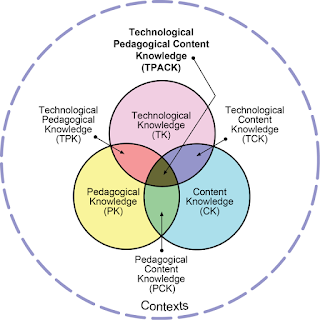
Elevator tale: this post tries to place TPACK in an ODE context. ODE works best when design is consistent, creative, collaborative, and comprehensive across the student tuition experience. These suggest a team-based approach to TPACK, involving specialist TEL and learning design roles working with subject experts. This teamwork often leads to tensions, which might be managed through a sound design methodology (such as Agile). In the previous post I provided an overview of TPACK and noted that "The goal for all TEL practitioners and online educators is the nirvana of TPACK, where Technology, Pedagogy And Content Knowledge all synergise into an optimal learning experience for the student." In this post I want to suggest how that nirvana might be reached in online and distance education (ODE) contexts. It's important to begin with a description of the main elements of the online and distance context of practice. Four foundational principles for effective online distanc...
TPACK Part 1: An overview

Image
In a previous post I mentioned reading through Matt Bower's Design of technology-enhanced learning , and how more posts would likely be sparked by it. Bower's second chapter prompted this post, as, he rightly points out, TPACK "highlights the interconnected nature of key dimensions of technology-enhanced learning" (p.20). This is the first of two posts, 1) explaining TPACK and 2) suggesting a nuance to it for the purposes of open and distance education (ODE) and effective TEL.  If you're unfamiliar with TPACK there are various introductions on YouTube, with options depending on how much of a hurry you're in. There is TPACK in 3 Minutes ; TPACK in 2 minutes ; and, what looks to be the record holder for brevity, a 1:49 introduction . This somewhat longer  clip by Matthew Koehler provides a very useful history of its development, and introduces its open future. Reproduced by permission of the publisher, © 2012 by tpack.org A very useful reference we...

Micro-, meso-, macro-levels of TEL

Image
I’ve recently been thinking about TEL in the context of quality assurance and enhancement (QA and QE), partly inspired by trying to establish some TEL standards for learning design. It occurred early on that which standards might be appropriate depends very much on the level of practice you’re concerned with. The theme of the next EDEN conference in Genoa is “ Exploring the micro, meso and macro: Navigating between dimensions in the digital learning landscape ”. The three levels of micro, meso and macro encourage different views of practice which are extremely helpful. But what do these levels mean? Fortunately, the three levels can be made to apply to all types of products and services - making illustration easy. Consider your phone; it consists of many features (operating system, camera, storage capacity, etc) that combine to form a single product (your mobile phone), which operates within a given context (the 4G network of your telco). Or, your car; again, a collection of ...

Gains in online learning since 2010

TeachOnline.ca , a good source for online learning trends and info, has released a high-level view of what we've learned about online learning since 2010 . It's a good state-of-the-art summary, and a useful reference. The five questions are not my main interest here; what caught my attention is the "biggest gains in online learning since 2010" list: "Wider acceptance of online learning as being not significantly different in terms of learning outcomes than face-to-face learning", citing Russell's nsd work .  "A deeper understanding of the importance of instructional design and the ways in which course design can better engage students in their learning". "A strong investment in the professional development of faculty and instructors – more focused engagement in how best to leverage online environments for learning". "A renewed focus on learning outcomes and, more recently, competency- and capability-based learning." ...

Innovation: A framework #2

I've submitted a response to the current Productivity Commission exercise considering aspects of the New Zealand tertiary education system. Unsurprisingly it has an explicit focus on innovation, which seems a key theme right across higher education providers at the moment. My current role sees me responsible for a fantastic team of dedicated learning and teaching innovators, and I'm proud to be able to say that their ideas really rock my world from time to time. I'm even prouder to say that I am actively encouraging them to make me uncomfortable. My interest in innovation goes back to - I'm embarrassed to say - last Millennium , when I studied entrepreneurship as part of my BMS at Waikato University. I was greatly influenced by reading the late, great Peter Drucker and encountering the theory of Joseph Schumpeter . The lessons from these classes, innovation in the context of entrepreneurship, have guided my interest in online distance education right from the start....

Learning, Part 2: On schemata and growth

Image
We don't just store bits of knowledge as stacked Lego bricks. Instead, we assimilate new knowledge within the stream of what we already know. In turn, the newly assimilated knowledge influences the stream of how we interpret new knowledge. In Making it stick , Brown, Roediger III and McDaniel define learning as "acquiring knowledge and skills and having them readily available from memory so [one] can make sense of future problems and opportunities" (2014, p.2). Learning, then, is a process of assimilation and extension. Sort of like a smudge.  The process of learning is often described in terms of a developing schemata   (Wikipedia article again highly recommended!) whereby what we already know both determines and changes as the result of what we learn. Such development might be equated with transformative learning , whereby an education doesn't just shape what we know; it also fundamentally changes our view of the world. It is here that the cognitive sciences ...

TEL innovation: A framework

It seems TEL and innovation are terms eternally linked. While much of actual TEL practice is rather predictable (not in the sense of it somehow being disappointing), TEL practitioners themselves are often driven by a desire to be more innovative, to always stretch the limits of what is done. Stakeholders and institution leaders are likewise interested in TEL innovation. But what exactly constitutes innovation? The term innovation is a much-used, yet seldom-explored term. Only somewhat helpfully, innovation is defined as " something new or different introduced " and as " a new idea, more effective device or process ". Innovation is most certainly perspectival, in that what one person would describe as innovative may not be considered innovative by another. Innovations might justifiably be at either extreme of tiny ("that's nice ") or incredibly significant ("that changes my understanding of what can be done!"), just as they might be eith...

The perfect answer to a poorly understood question

In a logical turn of events, Udacity, the online educational service founded by artificial intelligence guru and ex-Googler Sebastian Thrun, is offering a new set of tech degrees that guarantee a job in six months or your money back. ( ElecCafe.com ,  Code School Udacity Promises Refunds if You Don’t Get a Job ).  Now this is very, very good news. It demonstrates how achieving career qualifications can finally overcome the unsustainable and, let's face it, unjustifiable debt that characterises higher education worldwide. Education is clearly in need of a "gale of creative destruction", to quote Schumpeter . There is much to applaud here. However, philosophically there is also much to be concerned about. The same article exposes the underlying assumptions around the approach taken by Udacity's Sebastian Thrum: “The ultimate objective of education is to find people a job” Hmmm. Finding a job is a great outcome, and in purely economic cost/benefit analysis it...

Into cognitive theory: Making it stick, How we learn, and more smudging

I recently finished reading Make it stick  by Peter C. Brown, Henry L. Roedigger III, and Mark A. McDaniel, published 2014 by Harvard University Press. The Kindle version is available here ; a summary version is also available on Kindle here . What I like about the book is summed up in this paragraph: Much of how we structure training and schooling is based on learning theories that have been handed down to us, and these are shaped by our own sense of what works, a sensibility drawn from our personal experiences as teachers, coaches, students, and mere humans at large on the earth. How we teach is largely a mix of theory, lore, and intuition. But over the last forty years and more, cognitive psychologists have been working to build a body of evidence to clarify what works and to discover the strategies that get results (p.7).  The difference is between common sense (likely a projection of our own preferences!) and evidence when it comes to promoting effective learning. Wi...

Learning, Part 1: The learning comes first

It's a curious thing, the acronym TEL. The 'Technology' part comes first. I much prefer "Learning Enhanced by Technology" for the subtle reason that it puts the horse in the right place. Anyway. In this blog, it's the 'Learning' bit that leads. So, an orientation to learning as I consider it. Learning is one of those terms used rather too casually, a word with such broad and everyday use it can describe almost anything. I recall the most memorable learning experience of my MA: defining the term "interactive", in the context of e-learning. Is merely clicking on something interacting with it? From a certain perspective, yes... but true interactivity implies reciprocation. The thing being clicked should be able to also interact with the one clicking. Once you think about "interactive" in this term you become that much more critical of claims related to it. How we define terms ultimately reveals our assumptions about them. For the...

TEL-lingit like IT is

OK, so the title’s try-hard. TEL is “Technology Enhanced Learning”, an aspect of education I’ve been professionally involved in since 2000. IT is “information technology”. This blog explores TEL from the perspective of a practicing theorist. I’ll try not to be too clever with the word plays. This blog’s domain is probably bad enough for geeky cleverness to be entirely out of my system! What I will always try to be, though, is informed by literature and primary studies. It’s important that I give some context for what will follow. I agree entirely with Anderson & Zawacki-Richter that online distance education: is a discipline in its own right. may apply a broad social sciences-based research methodology, and although it is most appropriate, the field is eclectic and should allow for, and value, a multiplicity of research paradigms including positivist, interpretive, critical, and pragmatic research paradigms. is relevant to both distance learning and information and co...